Showing posts with label James Scott Byrnside. Show all posts

8/24/25

It's About Impossible Crime (2025) by James Scott Byrnside

Last time we heard of James Scott Byrnside was a short story, "The Silent Steps of Murder," posted on his blog as an appetizer to his upcoming, then untitled collection of original short stories – nearly all were still developmental stage at the time. So it took about a year and a half for the collection to materialize, but early June finally saw the publication of It's About Impossible Crime (2025). A collection of five, relatively longish stories dedicated to MacKinlay Kantor and William Spier. The title of the collection is, of course, a nod to Kantor's short story collection It's About Crime (1960) which include his two impossible crime stories "The Strange Case of Steinkelwintz" (1929) and "The Light at Three O'Clock" (1930). Spier was the radio director who worked on The Adventures of Sam Spade and Suspense series. So the tone for these stories is set!

It's About Impossible Crime starts out with the aforementioned "The Silent Steps of Murder," but already reviewed as part of "Locked and Loaded, Part 4" after it was published on Byrnside's blog. I'm not going over the story again, however, there are a couple of differences between the original and final version of the story. Byrnside originally intended It's About Impossible Crime to have an overarching storyline, concerning an enterprising serial killer who had already strangled seven women, which got scrapped. So references to that case do not appear in this final version and the fun little challenge to the reader was scrapped as well. Other than those changes, "The Silent Steps of Murder" is true to the original version I read and enjoyed last year. Simply a great retro-GAD story.

The second story is the intriguingly-titled "Where There's Smoke, There's Pazuzu" which begins with an ominous phone call to Rowan Manory, the best private detective in 1920s Chicago. A muffled voice tells him a man, named Burt Parnell, is about to be slaughtered in his office, on the third floor of the Pinnacle Place, but warns the detective there will be nothing to solve – because "this murder will be a completely supernatural affair." Manory and his assistant, Walter Williams, go to the building to investigate. When they arrive, the fire brigade is already present to put out a fire in Parnell's office, but the door is locked from the inside and they need to get out an axe to open it. Inside the partially burned office, they find what's left of Parnell sitting behind his desk without a head and his entrails spilled out on the floor. The office was turned inside out, but "no one other than the victim was found inside."

So another seemingly impossible murder for the two Chicago gumshoes, but Manory knows "the solution always lies within the bounds of reality" even when demonology rears its ugly head. In this case, the ancient demon Pazuzu of The Exorcist fame who came along with a curse placed on Parnell. This case has a personal, painfully grounded aspect for Williams, a veteran of the Great War. The daughter of Parnell is engaged to the son of an old friend from the trenches. And learns from him most of their friends who made it out have fallen on hard times or passed away, which gives Williams a pang of survivor's guilt. So a jam packed story and a pretty good one at that. I only pieced together the locked room-trick, but the murderer's identity and well-hidden motive took me by surprise. Another very well-done retro-GAD locked room mystery.

"Instrument of Death" is a non-impossible crime story, but, curiously enough, probably the best piece of detective fiction Byrnside has produced so far. Violet Reynolds, outwardly happily married, who fears her husband, Bobby, no longer loves her and decides to consult a spiritual medium. Madame Dunkel has some bad news: she sees a man standing over her corpse. A big, ugly man. And it will happen very soon ("your fate is sealed"). This large, ugly man is introduced to the reader as Dickie Daubert when he's busy hiding the body of Julie McPhee in her attic. Julie is a friend of Violet, who recently came into possession of a valuable violin, which Dickie wants to get his hands on – no matter the cost. What he has to find out is whom, of Julie's friends in the orchestra, is taking care of the violin as the bodies begin to stack. There are, however, only so many bodies you can litter across Chicago, before it attracts the attention of Manory. This time assisted by Officer Kegan, because Williams is out of town.

So without an impossible crime and a big, dumb violent brute strangling and stabbing people, "Instrument of Death" sounds more like something out of an hardboiled pulp magazine than a detective story proper. But rarely has appearances been so deceiving, even in our genre. When Dickie closes in on Violet, the story begins to twist and turn with the same brutality as the murders. I didn't see that ending coming at all and that final scene was very effective. Like a hardboiled Ellery Queen or a substantially-plotted Mike Shayne story. My favorite from this collection!

"The Preminger Curse" is an unapologetic throwback to the Gothic tales of crimes and suspense from the Doylean era of the genre. Manory travels down to Cairo, Illinois, to attend the reading of the will of two ex-clients, Dolph and Sophie Preminger. Manory is mentioned in their will and takes Williams along to the rundown Preminger mansion to see what's all about, because late changes to a will is never a good sign. When they arrive, they find a tensely gathered family and the reading of the will does very little to lessen the strain. Jasper Dunn, family lawyer, tells their daughter and younger son, Beverly and Timothy, they'll receive one hundred thousand dollars each ("that's... significantly less than it used to be"). Robert, oldest son, only gets a measly twenty-five thousand dollars. Their adopted brother, Simon, gets two hundred and fifty thousand dollars for giving his adopted parents so much joy when they were abandoned by their own children. Finally, there's their only grandchild, Ernest, who was the only child of their late son Cornelius. He gets the mansion, grounds and two millions worth in assets under one peculiar condition that comes with even stranger comments.

They must remain at Preminger mansion for the next twenty-four hours and should Ernest "commit the crime of murder against any blood relative," his "inheritance shall be forfeit" and the estate to be liquidated – to be "divided equally among the surviving heirs." Reasoning behind this strange condition is the Preminger Curse. In the 1700s, the Premingers were saddled with a burdensome curse, "one of the Preminger offspring will go mad and attempt to kill the rest of the family" every other generation. It happened twice already and the last time nearly wiped out the entire family. Which is why there's only one grandchild. Cornelius was the only one who defied his parents wishes and had a child. So the whole family were terrified of Ernest and was treated abysmally as a child, which included being locked away in room with barred windows and a padlock on the door. That left him with a personality disorder.

So the conditions of the will, frayed family ties, money needs and a less idyllic atmosphere nicely sets the stage for murder, which is why Manory was asked to be present – who's guaranteed a fat fee no matter what happens. Next twenty-four hours aren't uneventful with people getting killed or disappearing from locked and watched rooms. A barefoot, messy haired and almost ghostly figure of woman was seen dancing wildly in the rain. While the locked room-tricks are simple, straightforward affairs, the strength of the story is how it all folded together in the end cleverly (SPOILER/ROT13) haoheqravat gur zheqrere sebz fhfcvpvba. "The Preminger Curse" is the longest story in this collection, but not one that overstayed its welcome for even a single page. A great, very well-done homage to those Victorian-era mysteries from Doyle's days.

The fifth, and final, story is "Cue, Murder!" begins on New Year's Eve in the apartment of Atlee Burroughs, a stage director and teacher, who's entertaining a student, Paul Chase. They interrupted by an argument coming from the apartment below, "pipes in this building carry noise," where a former, Hollywood-bound student lives. Burroughs and Chase overhear Jonathan Keltner arguing with someone who brought a knife and a plan, "when they find your corpse, the door will be locked and the key inside." So they call the police and the responding officer kicks down the door to reveal Jonathan Keltner's body, but why was his body rolled inside a rug? And why is there a pile of celluloid strips lying on the floor? A locked room murder in Chicago naturally brings Manory to the scene of the crime. I don't think the central conceit is going to trick the seasoned, cynical armchair detective, but how it was done is a little trickier with an interesting, risky (ROT13) hfr bs n pbhcyr bs hajvggvat nppbzcyvprf juvpu urer vf creuncf cersrenoyr gb n pehqr erpbeqvat bs na nethzrag orvat cynlrq. On top of that, the locked room-trick is, given the circumstances, simple and practical without being routine or old hat. And it played on a locked room principle that has always fascinated me (ROT13: znxvat na haybpxrq qbbe be jvaqbj nccrne gb or gvtugyl ybpxrq). This all placed against the seedy, backstage world and goings on of the theatrical world and its crowd makes "Cue, Murder!" a solid story to close out the collection.

So, when it comes to the overall quality, the stories collected here range from solid to superb and even with only a handful of stories that's an accomplishment. You always have to expect one, or two, duds, but not It's About Impossible Crime. They're all Golden Age worthy whodunits in which Byrnside showcases he as skilled in hiding murderers as he's at getting them out of tightly locked rooms and impossible situations. That's also my only complaint. For a collection titled It's About Impossible Crime, it hasn't all that much to say about its impossible crimes. "Where There's Smoke, There's Pazuzu" and "Cue, Murder!" are the only two stories really deliver as impossible crime stories with "Silent Steps of Murder" underplaying its impossible situation and the two locked room murders in "The Preminger Curse" being very minor. "Instrument of Death," best story of the collection, has none at all. Not that it takes anything away from them as first-rate, neo-GAD mysteries, but was looking forward to picking apart a few meaty locked room puzzles. So take the locked rooms as a little bonus on top of five excellently written and constructed detective stories. I hope to see more of Manory and Williams in the future. Don't pull a vanishing-act on us, James! Remember, you promised to write Time Seals All Rooms. :)

3/12/24

Locked and Loaded, Part 4: A Selection of Short Impossible Crime and Locked Room Mystery Stories

I always try to somewhat vary the type of detective novels and short stories discussed on this blog. For example, I recently reviewed James Ronald's pulp-style impossible crime novel Six Were to Die (1932) followed by a character-driven whodunit by Nicholas Blake (The Dreadful Hollow, 1953), two Japanese manga mysteries (Motohiro Katou's Q.E.D. vol. 35-36) and J.S. Savage's retro-GAD The Mystery of Treefall Manor (2023) – which I think is varied crosscut of our corner of the genre. There's, of course, a difference between trying and succeeding. A firmly established tradition on this blog is that the locked room mystery is omnipresent and impossible to escape. Whether discussing Golden Age mysteries, their modern-day descendants or the detective stories currently getting ferried across multiple language barriers. The locked room is always present.

So, despite my attempts to keep everything somewhat varied, the blog regularly goes through periods where every other review is tagged with the "locked room mysteries" toe-tag. I'm simply obsessed fascinated with the damn things. This blog is currently going through one of those periods, but this time, I've an excuse a pretty good reason to fanboy all over them make a rigorous study of them.

Last year, I put together "The Locked Room Mystery & Impossible Crime Story in the 21st Century: A Brief Historic Overview of the First Twenty (Some) Years." I very soon realized I should have waited until 2025 as two more years would have given a much clearer picture of the current developments. So the plan is to eventually do a follow-up focusing solely on the ten-year period 2015-25, which is why I have been building a small pile of contemporary, retro-GAD mysteries. Not all of them are of the impossible variety, but most are and intend on decimating that pile in the two, three months ahead – interspersed with some golden oldies. So that's what you can expect in the coming weeks and months, but first need to get some odds and ends out of the way.

I previously compiled three posts under the title "Locked and Loaded," part 1, 2 and 3, which reviews uncollected short stories. This time, I had a handful of uncollected stories from the past 60 years (1963-2023) that I needed to get out of the way.

Lawrence G. Blochman's "Murder Behind Schedule," originally published in Clues for Dr. Coffee (1963) and reprinted as "Young Wife" in the November 17, 1963, publication of This Week. A very short, but legitimate, impossible crime story somehow not mentioned in Robert Adey's Locked Room Murders (1991) nor Brian Skupin's Locked Room Murders: Supplement (2019). This is the perfect filler material for locked room-themed anthology as it's short, simple and not devoid of interest. Dr. Daniel Webster Coffee, chief pathologist at Pasteur Hospital, is trying to work on New Methods of Post-mortem Diagnosis of Drowning when Lieutenant Max Ritter whisks him away to the scene of a very curious crime ("...like a case for that Dr. Gideon Fell you made me read about last summer"). Michael Waverly is a patron of the arts and a hard businessman, "people either worshiped him or hated his guts," who collected enemies left and right. Even at home. Waverly's marriage is on the rocks as his wife is having an affair with the second violinist of the Waverly String Quartet and someone tried to kill him only a week ago. Ritter received a frantic call from Waverly, "he's after me again," followed by a groan, loud banging noises and then utter silence. So what, exactly, happened and how did the murderer manage to escape from a locked room?

Like I said this is a very short, good and cleverly constructed detective story with an interesting and even realistic take on the classic trope of a murder inside a locked room. A locked room situation that would not be out of place in an episode of CSI. Despite being, what can called a realistic impossibility, Mike Grost points out on his website that the story "contains a gracious homage to John Dickson Carr" and "Carr in turn was a fan of Blochman" praising "his stories in print" – which got Clues for Dr. Coffee moved nearer the top of the pile. This short story and praise from Carr is enough to warrant further investigation.

Edward D. Hoch's wrote "The Locked Room Cipher" for a game-themed anthology, Who Done It? (1980), which hid the identity of the authors behind a code. So the story is not particularly well-known either as a work from Hoch's hand or as a locked room mystery.

"The Locked Room Cipher" stars the one-shot detective and newspaper columnist, Ross Calendar, who's invited by Terry Box to attend a high profile reunion. Terry Box had once worked in Washington, "doing something with codes and computers," but nowadays owns and runs "the hottest new disco restaurant since Studio 54," Sequin City – a place with some peculiar features. Beside giving its patrons the feeling they're in Hollywood or Las Vegas, every room and corner is under the watchful eye of closed-circuit TV cameras. The mirrored panels are actually one-way glass allowing viewers from above to watch the action below without being seen ("...something more suitable to a bank or gambling casino than a New York disco"). Now there's a reunion with three of Box's former colleagues from Washington who all worked with computers, ciphers or both. During the reunion, Box and Calendar witnesses one of them getting shot and killed on live CCTV inside the private dinning room with the door securely bolted from the inside. When they break down the door, the murderer has vanished and the only clue is a computer print-out of a cipher found in the victim's pocket.

Just as to be expected from Hoch, "The Locked Room Cipher" is a competently put together detective story, but the most difficult one to crack. The murderer is easily spotted and the method to create the illusion of an unseen shooter vanishing from a bolted room under camera surveillance is easy to anticipate. However, the passage of time turned it into a historically noteworthy "modern" impossible crime story. Sure, the technology used in the story is hopelessly outdated today, crude and clunky, but that crudeness gives it a charm of its own. More importantly, it's technological crudeness is what allowed Hoch to put a new spin on an old trick. In 1980, "The Locked Room Cipher" must have impressed as a promising example of what can be done with the classical locked room in a high-tech environment.

I wonder if detective fans of the future will look back on a story like "The Unlocked Locked Room Murder" (Gosho Aoyama's Case Closed, vol. 79) as crude and clunky, but quaint and pleasantly old-fashioned? After all, by that time they should be experiencing (which replaced reading) detective stories in which murderers create unbreakable alibis with AI-operated, holographic doubles or creating locked rooms with nanomaterials that can form a sealed door. Anyway...

M.P.O. Books' "De schilder die de waarheid liefhad" ("The Painter Who Loved the Truth," 2019), published as by "Anne van Doorn," shamelessly lingered on the big pile for years. And pretty much one of the main reasons for doing this compilation post. If you're not familiar with previous reviews, Books is the only Dutch crime-and mystery writer, past or present, who has written (good) impossible crime fiction in a significant quantity. From the early De blikvanger (The Eye-Catcher, 2010) and the excellent Een afgesloten huis (A Sealed House, 2013) to De man die zijn geweten ontlastte (The Man Who Relieved His Conscience, 2019) and Het Delfts blauw mysterie (The Delft Blue Mystery, 2023) under the Van Doorn name. And more than half a dozen short stories.

"The Painter Who Loved the Truth" could have just as easily been titled "The People Who Played Dominoes," because the story is plotted around the domino-effect as "crime sometimes takes the form of a game of dominoes, which are placed half a stone apart and upright" ("if the first one falls, they all fall"). That proved to be the case when an outgoing minister, Herman van Grootheest, is shockingly shot to death in his vacation home on Texel, "the first assassination of a prominent politician since Pim Fortuyn," but the police soon have a prime suspect, Joost Leijendekker – a house painter who was in possession of the murder weapon. And that's not the only damning evidence the police uncovers. During a reconstruction on the island, Leijendekker manages to escape and his flight ends on the doorstep of the two private investigators of Research & Discover, Robbie Corbijn and Lowina de Jong.

Leijendekker pleads he's innocent and Corbijn wants to help "the most wanted man in the Netherlands," but the painter is not exactly making it easy by insisting the gun was in his possession at the time of the murder. Not only in his possession, but safely under lock and key! Nobody except him knows the code to the safe. The trick to explain this impossibility is a neat one. However, this story is even better in its cause-and-effect structure as Corbijn and De Jong have to pick apart a series seemingly unconnected incidents that proved to be domino stones toppling one after another, which created the circumstances allowing for the murder to happen. It's a pleasing effect.

Tom Mead is a prominent member of today's locked room revivalists who signed his name to three novels, Death and the Conjuror (2022), The Murder Wheel (2023) and the upcoming Cabaret Macabre (2024), and a growing list of short stories – which I wish were easily available. Preferably in one place like a proper short story collection. One easily accessible short story from Mead you can read right now is "Jack Magg's Jaw" (2022).

"Jack Magg's Jaw" was published on The Strand Magazine website on September 30, 2022, as part of a competition to win a Locked Room Prize pack comprising of a hardcover copy of Mead's Death and the Conjuror, Otto Penzler's Golden Age Locked Room Mysteries (2022) and tickets for an escape room. All you had to do is solve the problem of the titular jaw and a small matter of a seemingly impossible murder. Joseph Spector, a retired magician and amateur detective, travels to the dark, rambling country house of Cliver Stoker to attend a slightly macabre weekend party. Stoker has his own private black museum ("behold... my museum of murder") and his most prized possession is the jawbone of a notoriously brutal highwayman, Jack Magg, who was executed in 1740. Every guest at the house party wants it. Stoker tells them they'll get to bid on it the following day, but, until then, it's locked away behind a steel door protected with a time lock that's "utterly impenetrable." When the morning comes and time lock runs out, the door opens to reveal a body inside what should have been a completely inaccessible vault. A very short, but good and fun little impossible crime story in which Mead's love for Clayton Rawson and Jonathan Creek bleeds through.

After last year's Monkey See, Monkey Murder (2023), James Scott Byrnside is currently working on a collection of short stories featuring his two Chicago gumshoes from the Roaring Twenties, Rowan Manory and Walter Williams. On the last day of 2023, Byrnside posted the first short story from that future collection, "The Silent Steps of Murder," on his blog as a New Year's present. Thanks! Very much appreciated and enjoyed!

"The Silent Steps of Murder" begins with Rowan Manory and Walter Williams out and about on New Year's Eve, "Chicago was ready to bid farewell to 1927," when they hear someone yelling murder. A young beat cop, Quinn, who immediately recognizes Chicago's famous detective and tells Manory he heard a loud crash, or noise, coming from one of the apartment buildings on his beat. When he goes to investigate, Quinn finds the body of the woman who lives there with a gunshot wound to the chest and stab wounds to the face. The state of the room suggests a robbery gone wrong or, perhaps, arranged to appear like a botched burglary that ended with a brutal murder. Just one problem. The murderer has to be still in the building, because the only footprints in the snow outside belong to Quinn. Manory assures Williams that Quinn is not the murderer, but, if not Quinn, who else could have left the place without leaving footprints?

There's a challenge to the reader, "Rowan has already solved the case. Have you? Here are some questions you should be able to answer," but it took me until after that point until things began clicking into place. Even then, I considered another variation that was actually mentioned in the comments. However, the solution deserves a blue ribbon. A bold move turning the story from an impossible crime story into a grand-style whodunit. This is exactly what I hoped envisioned would emerge from the Golden Age renaissance of the past decade. Go read it now and I look forward to complete collection which appears to have an overarching storyline.

So this rambling has gone on long enough. Next up is a (non-impossible) gem (I hope) from the 1930s.

11/16/23

Monkey See, Monkey Murder (2023) by James Scott Byrnside

The 1920s began in the United States with an amendment to the constitution banning the sale of beer, wine and spirits, effective January 19, 1920, but outlawing alcohol to battle and reduce domestic violence only made things worse – leading to the rise of organized crime and gangsterism. These were the days of bootlegging, rum running, speakeasies, rough (deadly) liquor and gang murders. Chicago brutally carved out a prominent place in the grim, bloody history of the Prohibition-era, but a fascinating chapter in US history nonetheless. And, today, fertile grounds for a historical, hardboiled crime novel. Or so you would think.

James Scott Byrnside had a different idea and took two incorruptible, 1920s Chicago gumshoes, Rowan Manory and Walter William, simply added some "locked-room murders, ghosts, vanishing killers, and so forth." The first three novels in the series, Goodnight Irene (2018), The Opening Night Murders (2019) and The Strange Case of the Barrington Hills Vampire (2020), are highlights of both self-published mysteries and new wave of impossible crime fiction. Monkey See, Monkey Murder (2023) is the fourth title in the series and the first one to probe the criminal underbelly of 1920s Chicago. This time, Manory's preference and ability to attract inexplicable, intricately-plotted murders and seeming impossible crimes can't keep him out of the way of a notoriously ruthless gangster.

Steven Rinehardt, owner of the Rinehardt Smelting Company out of Boston, has come to Chicago to expand his company with a new big metals plant, blast furnace and several factories, but it's a pleasure, not business, that gets him neck deep into trouble – dumping his fiancee to get engaged to a night club singer. Lulu Raspin is contracted to Ivan "The Flesher" Florkowski, "club owner, bookmaker, extortionist, murderer and gang leader," who not exactly thrilled the singer ran off or that her loved told him to pound sand over the telephone. Not a terribly clever strategy as "those who cross Ivan Florkowski end up in pieces, buried in concrete-filled barrels at the bottom of the river." However, something entirely different happened than the expected cement-filled barrels and a watery grave. Rinehardt took his new fiancee on holiday to Malaya, Southeast Asia, where a macaque "pummeled him and tore his face up" ("the poor son of a bitch doesn't even have a nose anymore"). Rinehardt believes the gangster is somehow behind the vicious monkey attack. A suspicion that's not alleviated when a gun-wielding man in a hazmat suit and gas mark is chased out of his house.

So this poses a really tricky, potential deadly problem for Police Sergeant Delbert Grady as he finds himself in an impossible position. The mayor had instructed him to make Rinehardt's happiness his top priority and demands Grady arrests Florkowski for attempted murder, but Grady's name is on Florkowski's payroll. Grady turns to the only incorruptible person in Chicago, Rowan Manory. If the city's finest detective can prove Florkowski has nothing to do with the strange attacks, Rinehardt or the mayor will believe it. And if he has something do with it, Grady has plenty of time to leave town ("some other dumb bastard can sign his own death warrant because I won't be around to have anything to do with it").

Rowan Manory and Walter William have their work cut out as people connected to the case either turn up very murdered or go missing. While the house is closely guarded by the Pinkerton Security Agency, the place is invaded by armed men and another angry macaque. This culminates with Florkowski unexpectly agreeing to a meeting at Rinehardt's home. Manory correctly predicts, "if the meeting goes anything like the other developments in this case, we'll walk away with even more questions."

This ends with the discovery of the one of more bizarrely posed, pulp-style locked room murders I've come across in some time, which I'm not even going to attempt to describe, but it should almost go without saying another macaque is involved – necessitating a "Locked Room Lecture" to bring some clarity. Manory discusses with Williams the finite solutions and principles by which an impossible crime can be accomplished. And rejects Williams suggesting the murderer might stumbled across a new locked room idea: "Hogwash! There are no new principles. Repackaged? Yes. Renamed. Sure. Altered with technology? Fine. Hidden within the details of a plot? Absolutely. But new? No." Just a matter of finding the right locked room principle "well hidden within the fabric of the plot." That being said, Monkey See, Monkey Murder should not be read solely for its locked room-angle or lecture. Byrnside's fifth novel is a better whodunit, superior even, than impossible crime story. One of those incredibly difficult, slippery and treacherous tightrope walking-acts that would have ended in a nasty fall in the hands of a less talented writer and plotter. Just very pleasing and rewarding to see something like this being produced again in the West. By comparison, the locked room murder and its explanation underwhelmed after such an intriguing presentation and lecture on the subject. Manory warned the reader the trick would rely on a well worn, well hidden principle, but even then, the locked room-trick felt very basic and unsatisfying. Particularly, when the change of one or two small details would have allowed for another method to leave a locked crime scene behind. A trick practically custom-made to the circumstances of Rinehardt's house and the locked room at the time of the murder.

So here's my solution to Monkey See, Monkey Murder's bizarre locked room situation: Manory notes in the story the door has a so-called Ryerson bolt-lock, "only lock that could not, under any known circumstances, be manipulated from the outside," because "weight and unique vertical movement made it resistant to magnets, strings, and any other makeshift tools." The key sticking inside the keyhole didn't add an extra layer to the impossibility or posed an obstacle to any trickery. So it could have just as good been found lying in the middle of the room without diminishing the impossibility of the locked room slaying in any way. That would have opened another door hiding in plain sight. During the story, work is still being done on the house and construction material is strewn all over the place such as canvas hoses. A canvas hose can be used to guide the key down the chimney, through "the tiny spaces of the curlicue design" of the iron grate to the fireplace, which "can only be locked into place from inside the room," back into the room now appearing to be locked from the inside – only key lying right there on the floor. After that, the murderer pulls the canvas hose back up. I don't always demand blistering original, grandiosely-staged tricks from a locked room mystery. Just something to match its presentation and this one demanded something that at least looked a little bit more complicated than a basic trick. Even if it actually hinges on a basic trick.

Fortunately, Monkey See, Monkey Murder is so much more than only a locked room mystery. Byrnside packed the same ingenuity, vigor, sportsmanship and understanding of the detective story to craft an excellent, hardboiled whodunit that made him the leading light of the traditional, self-published (locked room) mystery novels. While it would have been nice if the locked room murder would have developed into something better, it's not the end-all. Particularly, if behind that locked door is, what's in every other regard, a first-rate detective story playing the Grandest Game in the World. I very much look forward to the next title in the series or perhaps another crazy-ass piece of pulp like the standalone The 5 False Suicides (2021). Either way, I'll be there!

2/11/22

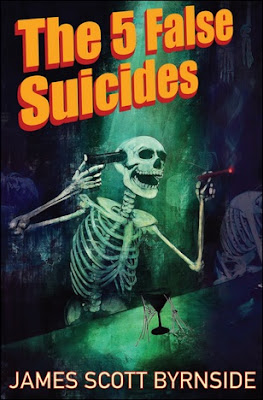
The 5 False Suicides (2021) by James Scott Byrnside

Two years ago, James Scott Byrnside completed his Rowan Manory and Walter Williams trilogy, Goodnight Irene (2018), The Opening Night Murders (2019) and The Strange Case of the Barrington Hills Vampire (2020), which in turn performed an amazing hat trick – back-to-back gems of traditionally-plotted, slightly noir-ish, detective novels. Stories brimming with bizarre and sometimes gruesome murders, locked room mysteries, dying messages and false-solutions that can only be compared to the works of Byrnside's Japanese counterparts of the shin honkaku school or Paul Halter at the top of his game. Regrettably, Byrnside is currently the only writer in the Western world who's crafting these kind of ambitious, tightly-plotted and fairly clued detective novels commonly associated today with the East. So it was a joy when his fourth novel was finally published late last year! 

The 5 False Suicides (2021) has a title and premise that immediately invites the reader to draw comparisons with John Dickson Carr's The Four False Weapons (1937) and The Case of the Constant Suicides (1941), Agatha Christie's And Then There Were None (1939) and Peter Lovesey's Bloodhounds (1996). This is not that kind of (locked room) mystery novel. The 5 False Suicides is "some stand-alone, crazy-ass piece of pulp" dedicated to Fredric Brown, which should give you an idea what to expect. Or so you would think! 

The 5 False Suicides takes place in 1947 New Sweden, Maine, where librarian Gretta Grahame formed a book club, the Murder-mystery Appreciation Society of New Sweden (MASONS), on the recommendation of her therapist to combat her shyness. Gretta becomes "incredibly communicative" whenever she gets to talk about the intricacies of the detective story. So why not use it to her advantage. The first two members to join the MASONS were Gretta's only real friends, Faye Withers and Georgie Danvers, but an advert on Gretta's library's whisper wall drew five more members into the group – two couples and a single. Olive Tennant is the daughter of a local toothpick mogul and joined up with her husband, Harry, in addition to an elderly couple of retirees, Tom and Alice Mower. The single is a strongly opinionated hotel porter, Oscar Strom. One of their weekly meetings fills out the first chapter as they kindly bicker and banter about what to read next and picking apart Oscar's homespun impossible crime method, which pleasantly reminded me of the after-dinner discussions from Isaac Asimov's Black Widower series. A chapter ending with the ominous promise that "most of the membership would be dead in a fortnight" and "one of the members would be a murderer."

A long string of tragic deaths that began with Gretta's estranged uncle, Scotty Grahame, calling his niece to inform that her Aunt Suzie died from an overdose of barbiturates and the police ruled it a suicide. A similar fate befell Gretta's mother and she recently tried to take her own life, which apparently runs in the family. But not without a reason.

Scotty tells Gretta that her grandfather, Andrew Grahame, put "a curse on his own flesh and blood," back in 1907, which "has been murdering the Grahame family for the last thirty years" and they're the last two remaining Grahames – very likely next to fall victim of the curse. Andrew Grahame had help with his curse from a Hungarian mystic, or male-witch, named Boroqe Rieszak and he wants to help them lift the deadly curse. So he asks Gretta to come to his hotel room and drive together to the meet the Hungarian witch, but, when she calls back the next day, a policeman answers the phone. Scotty had committed suicide in his hotel room!

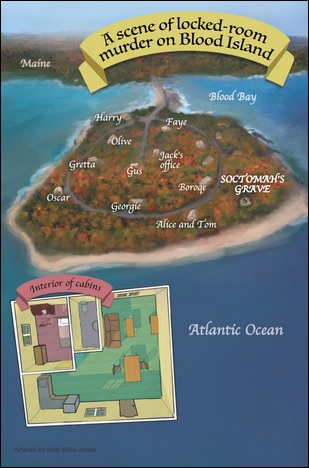
Nonetheless, Gretta decides to go through with meeting Rieszak, accompanied by Faye and Olive, who reveals their family and curse is tied to Blood Island. An island on the south coast of Maine connected to the mainland by a natural, limestone bridge and had been cleared in 1825 of its native population to make way for "a heavenly getaway for the wealthy," but one remained behind and hid in the island forest to plot his revenge. And massacred "the best of society" on their first night on the island. So the Indian was hunted down and he cursed his hunters, "may your loved ones suffer the same fate as I," before slitting his own throat. Gretta's grandfather was a Satanist and used to island curse to ensure that a special place in hell reserved for "those who curse their own flesh and blood," but, "when only one descendent of a Soctomah-cursed family remains," that "descendent can be freed of suicide by a ceremony." All Gretta has to do is gather a surrogate family to temporarily replace what she has lost and go to Blood Island, now called Heaven's Gate, to perform the ceremony. This is where the story moves from Carr-Christie territory to the borderlands of Hake Talbot and Theodore Roscoe.

Normally, it's "darn-near impossible to get a reservation on Heaven's Gate" at that time of year, but a wildfire is slowly consuming the south of Maine and a serial killer, "The Burlington Butcher," is likely hiding out in the dense forests of Heaven's Gate – who left a bizarre murder scene on the southernmost beach. A young woman had been butchered with a hunting knife, but "no footprints except those of the victim were found on the beach." So the island was not a particular popular holiday destination that seasons. Gretta goes to the island with Rieszak and some of the MASONS as her surrogate family, but they have hardly arrived before one of them apparently shoots and kills themselves in a cabin with the windows and door locked from the inside. Through the window, they saw the handle of the key sticking out of the keyhole. At the same time, someone else is found hanging from a noose with a mutilated hand. And then, as you can expect from the title, the story really begins to pick up pace.

Before getting to the plot crammed with impossible crimes, red herrings and false-solutions, the wonderfully executed, sometimes dark duality and meta-consciousness of the storytelling has to be highlighted with the MASONS almost being aware they're characters inside a detective story. They disapprove of the case possibly having more than one, independently, moving parts ("I don't like a mystery with too many moving parts") or having the sneaking suspicion they have “already come across the big clue” without having noticed it. So, under normal circumstances, people who prefer the "civilized murder" of fiction to the messy banality of real-life crimes, but, as Detective Brodsky put it so eloquently, "it ain't like those books by Dick Johnson Carter." This resulted in awkward, but very well handled, scene in which the MASONS tell Jack Munt, Ranger of Heaven's Gate, how intrigued and excited they were about his impossible murder on the beach. Munt responds with telling them the girl didn't die right away and how held her hand as she died. So, no, he wouldn't exactly describe the murder as exciting or funny. Even though the characters run around the island, simultaneously playing detective and getting culled, the story becomes quite grim as it nears its conclusion. Sometimes bordering on outright horror ("Gur fxva unq ohooyrq hc naq jnf abj orersg bs nal qrsvavat sbez pnhfrq ol nqurfvba gb gur obar"). Just like the second, gory murder from Goodnight Irene or the severed hands featured in The Strange Case of the Barrington Hills Vampire, there's a logical reason for everything in Byrnside's mysteries. This time, it has all the mad logic of dream.

Firstly, there's the locked room-tricks, real and false, which are contracted around principles that have been around for a while, but how they were presented and executed put a new spin on them – which is the next best thing to discovering an original and brand new locked room-trick. I liked how one of the tricks suggested was an updated version of a trick from a fictitious short story, "Five Deaths and One Lock," which surprised readers in 1889 as "they had no idea what [REDACTED] meant." But where The 5 False Suicides stands out is not as a locked room mystery with multiple impossibilities. But how all the moving parts and red herrings came together. And how they were pulled apart again. Planting "the big clue" in plain sight. Blurring the lines between the real and false-solutions culminating in that daring, uncertain, but ambitious ending. Something not every mystery reader is going to appreciate, but you have to keep in mind that this is supposed to be a pulp-style mystery in the spirit of Gerald Verner's The Royal Flush Murders (1948) and John Russell Fearn's The Man Who Was Not (2005) with a distinct touch of madness. I'm very fond of those two second-string pulp mongers. So add in a first-rate plot stuffed with fairly planted clues, treacherous red herring and false-solutions, you leave me with precious little to complain or nitpick about. 

Sure, The 5 False Suicides is perhaps too short a novel with characterization taking a backseat to the plot and storytelling. I can see how readers who like characterization would have appreciated a little more elaboration about certain character revelations. But speaking as an uncouth, plot obsessed detective fanboy with a taste for the pulps, the lack of characterization didn't bother me too much. To quote the great Dr. Gideon Fell, "I like some vividness of colour and imagination flashing out of my plot, since I cannot find a story enthralling solely on the grounds that it sounds as though it might really have happened." I do not care to hear the hum of everyday life and neither does the author of this crazy-ass piece of pulp. 

Byrnside only began to seriously read Golden Age detective fiction in early 2017, published his first detective novel in 2018 and continued to demonstrate the kind of genre awareness and understanding in his next two novels that I always assumed took years to develop and fine-tune. More importantly, Byrnside's four novels demonstrate how you can enrich your stories and plots by building on the rich history of your genre instead of discarding it as out-of-date and obsolete. A genuine prodigy of the genre and The 5 False Suicides carried on the streak of delivering quality, first-class detective fiction that fans and genre scholars of the future might look back upon as the dawn of a Second Golden Age (once again, no pressure). So you future detective fans and scholars better be grateful for having all of his novels at your immediate disposal. We had to wait years for The Jolly Roger Murders, Time Seals All Rooms and Goodmorning Irene to come out.

11/12/20

The Strange Case of the Barrington Hills Vampire (2020) by James Scott Byrnside

The locked room mystery and impossible crime story comes in many different shapes and forms, opening the door to endless possibilities and variations to kill, or disappear, people under circumstances that can only be described as miraculous – whether the victims were in a sealed room, closely guarded or in an open space. And then there are the miscellaneous impossibilities such as levitation, phantom fingerprints, predictive dreams and the physical alibi. So the possibilities really are endless and mystery writers have been tinkering with it ever since Edgar Allan Poe wrote "The Murders in the Rue Morgue" in 1841. 

There is, however, one type of impossible crime that appears to be incredibly restrictive without much room for innovation or originality. I'm talking about the no-footprints scenario. 

John Dickson Carr's name is synonymous with the locked room and impossible crime story, but even the master himself only produced two really good and original no-footprints novels, The Hollow Man (1935) and She Died a Lady (1943) – latter published as by "Carter Dickson." If you look at what other mystery writers have written, there are no more than a dozen novels and short stories that stand out as inspired and original. Some examples that come to mind are Hake Talbot's Rim of the Pit (1944), Norman Berrow's The Footprints of Satan (1950), Douglas Ashe's The Longstreet Legacy (1951), David Renwick's Jonathan Creek episode The Black Canary (1998) and two masterly done short stories, Robert Arthur's "The Glass Bridge" (1957) and Arthur Porges' "No Killer Has Wings" (1960). Japan also produced some fine examples (e.g. Gosho Aoyama's "The Magic Lovers Case") and recently Paul Halter came up with a creative variation on the no-footprints scenario in La montre en or (The Gold Watch, 2019). This short list of notable titles is why I've come to regard the no-footprints scenario as the most challenging and tricky impossible crime to tackle. A puzzle for experts.

So I was excited when the prodigy child of the Renaissance Era, James Scott Byrnside, announced his third novel featuring a killer who can apparently walk through walls and doesn't leave any footprints in the snow! 

The Strange Case of the Barrington Hills Vampire (2020) is a prequel to Goodnight Irene (2018) and The Opening Night Murders (2019), set in November, 1920, which takes Rowan Manory and Walter Williams, Chicago's finest, to Barrington Hills – located "deep within the recesses of untamed Illinois." Thomas Browning, a rich railway magnate, wants a reputable private detective to debunk a psychic, Madame Cuchla, who has convinced his business partner, Hadd Mades, that turning Barrington Hills in a resort town is a bad idea. Madame Cuchla claims the region is haunted by one of the town's most notorious past residents, Otto Savore. Someone believed by the locals to be a vampire who, in 1875, allegedly killed more than fifty people in a single night with "none of the doors or windows of his victims were trespassed" and "no footprints in the snow." So, quite naturally, the townspeople buried him alive and "no grass ever grows on the vampire's grave." Madame Cuchla warns that death will come if the ground is ever build on.

Manory tells Browning that "any number of Chicago-River gumshoes could explain" the parlor tricks employed by psychics for a third of his price, but Browning wants a reputable detective to convince Mades. Manory certainly delivers the goods as he not only explains Madame Cuchla psychic reading of Williams, ghostly knocking and a floating face that vanished in a puff of smoke, but also gives a solution to the vampiric bloodbath from forty-five years ago. So the opening alone is good enough to be added to the list of debunked séance mysteries, but the problems that follow are of a less conventional nature. And they're all "damned impossible."

A New Mapback!
Early next morning, Mades returns to the remote house, hammering on the front door and yelling blue murder, because the vampire is in the house and Browning is in grave danger. Mades shows Manory the developed photographs that were taken of the house the previous days and one of them shows a grotesque-looking creature standing outside the balcony door, "sharp nails were touching the glass," as if trying to enter. But how did the vampire get on the balcony? There's no way to reach the balcony from the outside and the freezing cold makes it unlikely someone was waiting on the balcony for the right moment to photobomb without being seen. So that's the first impossibility stumping Manory, but "an agonizing scream" quickly announces a second one.

Thomas Browning's body is found in the garage with a twisted spine, broken bones, a slash across his right wrist and two bleeding puncture marks in his neck, but how had the murderer entered, or exited, the garage – only footprints going from the kitchen door to the garage belong to Browning. Another set of footprints goes from the kitchen door into the direction of the forest. A third and fourth set of footprints go from the garage window and back into the forest. Finally, two footprints are found next to the skylight on the garage roof, but none of them explained how Browning could have been attacked and killed. The Strange Case of the Barrington Hills Vampire is brimming with impossible material. There's a past murder case in which severed hands were left in the bedroom of a locked house and a second murder is committed inside a locked bedroom while Manory was sitting guard in the corridor. However, the story should not be judged solely as an impossible crime novel. 

The Strange Case of the Barrington Hills Vampire has a small pool of suspects comprising of Browning's much younger wife, Madelaine, who sleepwalks and the reason why they have a live-in specialist, Dr. Sinclair. A daughter from a first marriage, Gertrude, who used to be married with a socialist associated with a band of hardliners, but he was "suicided" in a jail cell. She had not been on speaking terms with her father until he summoned her back home with the promise of a surprise. Howard Amorartis is a writer of supernatural horror and hopes his name will one day be as well-known as Poe, but now he has been commissioned to pen Browning's biography. Belby is the butler-chauffeur who's "not intelligent enough to devise a murder plan," but perhaps "subservient enough to carry one out." And there's always Browning's frightened business partner, Mades.

I think The Strange Case of the Barrington Hills Vampire is actually more accomplished as a whodunit than as a locked room mystery with a murderer who was hiding in plain sight (always satisfying) who had an original motive to engineer a whole series of otherworldly crimes. Just like in previous novels, the plot resembles a Matryoshka doll with multiple, interconnected problems that not only includes a plethora of impossible crimes and elusive murderer, but a dying message that had to be violently pried from the victim's clenched fist or why the murderer had no option to sever the hands of the second victim – a kind of corpse puzzle you normally only come across in Japanese shin honkaku detective stories. Add to this the excellent clueing, the characterization of the two bantering detectives and all of the various, moving plot-strands grasped in an iron-clad grip demonstrating why Byrnside might very well turn out to be the herald of a Second Golden Age.

A Classic Mapback
But what about the impossibilities? Can they stand toe-to-toe with the ten no-footprints novels and short stories mentioned above? Yes... and no. The plot is crammed with the impossible crimes, but quantity doesn't always mean quality and only two of them are good.

Firstly, while the murder in the snow surrounded garage didn't came up with a new footprint-trick, everything else about this tricky murder made it an excellent impossibility with a good explanation why the witness at the window saw him fight with an invisible entity. Honestly, the whole situation that brought about this murder was quite clever and something that would have gotten the approval of Carr. Secondly, the murder in the locked and guarded bedroom has a routine solution, where the locked door and guard are concerned, but Byrnside succeeded in making one of my biggest no-noes perfectly acceptable and logical. And then there's the reason why the murderer had to cut off the hands. Unfortunately, the explanations to the past case with the severed hands that were left in a locked house or how the vampire was able to reach the balcony were underwhelming.

Nevertheless, when the plot resembles a nesting doll and practically everything is done correctly, the less than impressive explanations to two of the impossibilities is a blow the story can easily absorb without any damage to the overall plot. Byrnside continued to be awesome with how he handled the ending. Chapter 17 is a Challenge to the Reader asking eight questions that have to be answered before the case can be considered solved. Manory gives his explanation of the case at the annual dinner of the Detectives Club and there's a Rival Detective in attendance, Miss Genevieve Pond, who plays armchair detective and tries to deduce the solution before Manory gives it. I suspect she'll either become Manory's love interest in a future novel or become an antagonist when Byrnside decides to tackle the inverted detective story with an impossible, but it's probably the former. After all, Manory needs someone to bounce off on. They're polar opposites, is what I mean.

So, a long, rambling story short, Byrnside performed the hat trick with three back-to-back gems of the Western-style, neo-orthodox detective novel covering various styles and subgenres. All three are historical mysteries written in the typical, hardboiled style of the American pulps, but plotted and clued like a traditional, Golden Age detective stories filled with locked rooms, dying messages and bizarre murders – which all pay subtly homage to some of the greats of that bygone era. Goodnight Irene was an ambitious debut and The Opening Night Murders showed prodigious improvement with its labyrinthine plot, which can also be read as the two of the longest fan letters everyone has ever written to Christianna Brand. Byrnside moved away from using Brand as a foundation stone for his work and the result is The Strange Case of the Barrington Hills Vampire is a fully realized, modern incarnation of the classic detective story that can stand on its own. One of the bright lights of 2020 and all three come highly recommended.

On a final note: sorry for the flurry of 2020 reviews, but had to rearrange some posts and cram them all in here.

6/15/19

The Opening Night Murders (2019) by James Scott Byrnside

Last year, James Scott Byrnside debuted with an ambitiously plotted, cleverly written historical (locked room) mystery novel, Goodnight Irene (2018), which he dedicated to one of the uncrowned queens of the Golden Age detective story, Christianna Brand – whose influence on Byrnside left a noticeable mark on the plot. Goodnight Irene was deservedly received with much acclaim and enthusiasm.

Surprisingly, in an interview with "JJ," of The Invisible Event, Byrnside revealed he had only been seriously reading classic detective fiction since January, 2017, when he came across an audio-book of A.A. Milne's The Red House Mystery (1922) on YouTube. This makes Goodnight Irene even more remarkable, because the characterization, plotting and writing showed a firm grasp and understanding of the traditional detective story.

I always assumed it took years to discover, develop and fine-tune your taste, which gives you an understanding of the genre as a whole, but Byrnside moved with prodigal speed from listening to Milne's The Red House Mystery to writing a Western equivalent of a Japanese shin honkaku mystery novel – potentially lightening the spark of a second Golden Age. I, on the other hand, can still be genuinely amazed at the sheer volume of detective fiction produced between 1920 and 1960. And the resulting endless procession of obscure, long-forgotten mystery writers who keep clawing to the surface.

So most of us where eagerly looking forward to Byrnside's second impossible crime novel, entitled The Opening Night Murders (2019), which promised to be a detective story along the lines of Brand's superb Death of Jezebel (1948). Well, I was not disappointed.

The Opening Night Murders is set in Chicago, 1935, and begins on a somewhat similar note as Goodnight Irene and Death of Jezebel.

Rowan Manory and Walter Williams are two Chicago-based private-detectives who are essentially Sherlock Holmes and Dr. Watson, but interact with each other more like Nero Wolfe and Archie Goodwin without them really resembling any of these characters – which makes them descendants, instead of cheap knockoffs, of those famous detectives. Their next intricately-plotted, elusive and puzzling headache of a case is brought to them by "the finest actress in all of Chicago," Lisa Pluviam.

Lisa and Jenny Pluviam are sisters who been in theater, in one form or another, their entire lives. They started in high school, "farted around flops and dives in Chicago for seven years" and studied in New York, which turned Lisa into a proper stage actress and Jenny became a director/playwright. So an unexpected inheritance from their estranged father placed in the position to open The Red Rising Theater and put on their own productions. The Balcony is one of those productions, written and directed by Jenny Pluviam, with Lisa Pluviam as the lead star of this promising play, but Lisa is "a little spooked" when she receives an anonymous death threat. A note had been left in her office, in the theater, promising she'll die on opening night and there's only a window of twenty-four hours in which the note could have been left – only seven people had access to the theater during that time frame. Two of them are Lisa and Jenny Pluviam. The others include four actors, Timothy Brown, Edward Filius, Allison Miller and Maura Lewis, rounded out by the grizzled stage technician, Sam "Grizz" Thompson.

I think the opening chapter excellently showcases Manory's experience and skill as an old, weather-beaten detective as he mines the story presented to them for facts and details, which allows him to make some accurate deductions about the characters and the play – which is always an open invitation to draw comparisons with Sherlock Holmes. However, here it wasn't done in order to dazzle the client or reader with amazing feats of deductions based on a particular type of clay or scratches on a pocket watch. Manory was earnestly probing the problem and this made him come across, in spite of his verbosity, as an honestly intelligent detective.

Lisa convinces Manory to come to the opening of The Balcony to keep an eye on her and act "sort of like a bodyguard," which might convince her would-be-assassin to abandon his, or her, plan. Sadly, this turned out not to be the case.

On the right side of the stage, there's "a twenty-foot-high tower with the two balconies side by side," on which Lisa and Edward's characters meet, but, during her balcony scene, Lisa toppled over the rail and plunged twenty-feet. She landed face first with "a sharp, sickening crack of her neck." Lisa had been all alone on the balcony and there were two-hundred people in the audience to back up that claim, but Manory is convinced one of his six suspect had planned and carried out, what looked like, the perfect murder. And now the story, or rather the plot, becomes a little tricky to discuss.

Years ago, I compared the plot of M.P.O. Books' De laatste kans (The Last Chance, 2011), one of the best Dutch detective novels ever written, to a kaleidoscopic photograph. A plot that initially appears to be a confusion of scattered, seemingly unconnected plot-threads, but, as the story progresses, the lens is slowly turned back into focus – creating a complete and coherent picture of the case. Byrnside has a similar plotting-style except with him there's never any doubt the plot-threads are connected, but the effect is pretty much the same. JJ hit the nail on the head when he called the plot of The Opening Night Murders a "mesmerizing, intoxicating performance."

The hook of The Opening Night Murders isn't simply the excellently positioned and executed impossible crime in front of two-hundred witnesses, but the way in which every single aspect and detail of the story logically dovetailed together in the end. This allowed Byrnside to play around with that beloved plot-device of puzzle-plot enthusiasts, the multiple interpretations/solutions, which is used quite effectively towards the end of the story. Simply amazing!

Once more, I can't give you too many exact details about this intricate, maze-like plot, littered with clues, but the second murder deserves a mention. A murder that's the exact opposite of the carefully planned, coolly executed murder of Lisa Pluviam. The second, gory murder was a frenzied killing carried out with a straight razor and kitchen knife. However, the murderer turned out to have a logical reason to go to town on this victim that you normally only see in Japanese shin honkaku mysteries, in which a dismembered or mutilated body often turns out to be a key-piece of the puzzle. Byrnside truly is a neo-orthodox mystery writer!

The Opening Night Murders is not simply a detective of cold, hard logic, but one that becomes very close and personal for the two detectives, which results in an unforgettable ending. Granted, I have read similar kind of endings in detective stories, but not quite like this one!

So, where the characters, plot and story-telling is concerned, I have practically nothing to nitpick about, except that the colorful vernacular of the characters seem very modern at times, but I have a piece of advice for Byrnside. Don't become a one-man tribute band by leaning too heavily on Brand as a foundation for your stories, because it's going to take away from your own ideas in the long run. Instead, you should follow the example of Paul Halter, a disciple of John Dickson Carr, who emerged from his idol's shadow to carve out a legacy of his own as a modern master of the locked room mystery. You can do it!

The Opening Night Murders has rich story-telling that logically navigates a beautifully designed, labyrinthine-like plot to its inevitable conclusion and hopefully a sign from the Gods (Poe, Doyle and Chesterton) that a second Golden Age is on the horizon. I'm eagerly looking forward to the third entry in the series, The Strange Case of the Barrington Hills Vampire (2020), which is a prequel and will be released next summer. I'm kind of curious to see how exactly R. Francis Foster's Something Wrong at Chillery (1931) has influenced the interaction between Manory and Williams (see comment-section).

On a final, semi-related note: I crammed this review in between my planned ones (still more than a month ahead of schedule) and this came at the expense of yesterday's review of The Doll Island Murder Case from the Kindaichi series. So, if you missed that blog-post, it's there.